Glass Half Full: The Real Reason Your Craft Beer Tastes Better at the Brewery
You've been there. You crack open a bomber of that limited-release double IPA you scored at your favorite local brewery, pour it into whatever glass was clean, and think — huh, it's fine. Then you head back to the taproom the following weekend, order the same beer on draft, and suddenly it's the best thing you've ever tasted. Same beer. Totally different experience.
This isn't a fluke, and it's not a placebo effect. There's genuine science behind why craft beer tastes the way it does when it's served correctly — and why even a small slip in temperature, glassware, or technique can flatten all the work a brewer put into that pint. We talked to brewmasters and certified Cicerones (think: sommeliers, but for beer) across the country to break it all down.
Temperature Is Everything — And Most People Get It Wrong
Here's the thing: the idea that beer should be served ice cold is mostly a marketing invention from the big macro lager guys. For craft beer, that logic falls apart fast.
"When you serve a beer too cold, you're essentially numbing it," says Marcus Webb, head brewer at a Colorado farmhouse ale producer. "The aromatic compounds that carry all the flavor — the fruity esters, the earthy hops, the malt sweetness — they need a little warmth to volatilize and reach your nose. Serve it at 34 degrees and you're just tasting cold."
Different styles actually have different ideal serving temperatures, and those ranges exist for real reasons:
- Light lagers and pilsners: 38–45°F — these are designed to be crisp and refreshing, so a colder serve works
- Pale ales and IPAs: 45–50°F — cool enough to stay bright and carbonated, warm enough to let those hop aromas pop
- Stouts, porters, and dark ales: 50–55°F — at this range, roasted malt complexity, chocolate notes, and coffee undertones open up beautifully
- Belgian ales and barleywines: 55–60°F — these are big, complex beers that practically bloom as they warm in your hand
The next time you pull a craft stout from the fridge, try letting it sit on the counter for five minutes before you pour. You might be surprised what shows up.
Why the Glass Isn't Just a Container
Ask any serious beer nerd about glassware and you'll probably get a longer answer than you bargained for. But the enthusiasm is earned — glass shape genuinely changes how a beer smells, tastes, and feels.
The most obvious example is the shaker pint, that squat, straight-sided glass you'll find at pretty much every sports bar in America. It's cheap, stackable, and nearly universal — but it's actually a pretty mediocre vessel for most craft styles. The wide rim disperses aroma before it can reach your nose, and the straight sides don't do anything to concentrate carbonation.
Contrast that with a tulip glass, which has a flared lip and a bowl that curves inward before opening back up. That shape traps volatile aromatics and funnels them toward your nose as you drink. For a Belgian saison or a hazy IPA loaded with tropical hop compounds, this isn't pretension — it's just physics.
"We actually did a blind tasting at the brewery where we served the same hefeweizen in a shaker pint, a Weizen glass, and a tulip," recalls Jamie Ostrowski, a Cicerone-certified beer educator based in Portland, Oregon. "Same batch, same temperature, same carbonation. The feedback was dramatically different depending on the glass. The Weizen glass won by a landslide — and it's literally designed to hold the foam and direct those banana and clove esters right at you."
A few glass styles worth knowing:
- Tulip: Great all-arounder for hoppy and Belgian styles
- Weizen glass: Tall and slender, built for hefeweizens and wheat beers
- Snifter: Short and wide-bowled, ideal for warming high-ABV beers like barleywines and imperial stouts
- Pilsner glass: Tall and narrow, shows off clarity and keeps lagers effervescent
- Stange: A simple cylindrical glass used for Kölsch — delicate and precise
You don't need a cabinet full of specialty glassware at home. But owning one good tulip and one pint glass covers a lot of ground.
The Pour Itself: There's Actually a Right Way
Most people pour beer by tilting the glass and easing it in to minimize foam. Turns out, that instinct is partially wrong — at least for most craft styles.
Foam is not the enemy. A proper head on a beer serves as a kind of aromatic lid, trapping volatile compounds and releasing them slowly as you drink. It also softens the carbonation on your palate, making the drinking experience smoother.
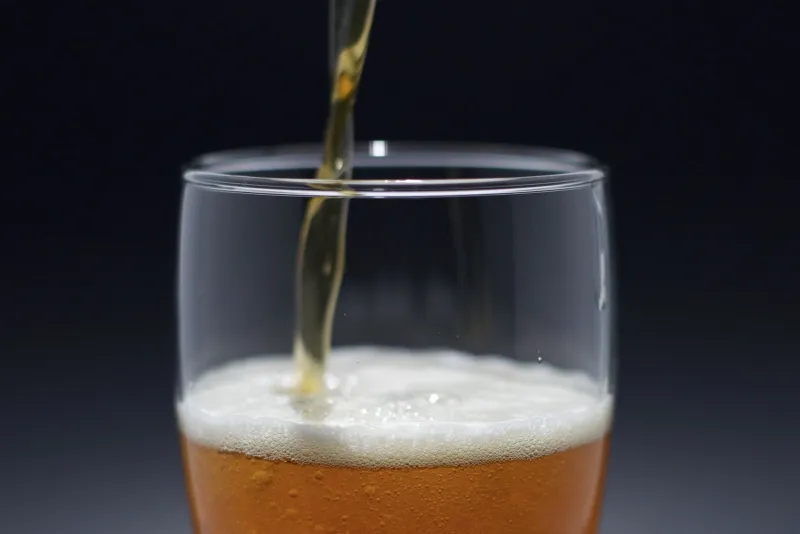
The classic two-stage pour works like this: hold your glass at a 45-degree angle and pour steadily down the side until the glass is about halfway full. Then straighten the glass upright and pour the rest directly down the center, creating a one-to-two inch head. This technique releases CO2 gradually rather than all at once, keeping the beer lively without making it a foam explosion.
For heavily carbonated styles like hefeweizens or Belgian tripels, you may want to rinse the glass with cold water first — this cools the glass and reduces nucleation points that cause excessive foaming. And for bottle-conditioned beers with yeast sediment, pour slowly and stop before you hit the cloudy stuff at the bottom (unless you want it, which is totally valid for certain styles).
"The pour is the last step in a long process," Webb says. "We spend months dialing in a recipe, weeks on fermentation, and a lot of thought on packaging. The pour is the handoff. It's the last mile. Messing it up is like cooking a perfect steak and then letting it sit uncovered for half an hour."
Bringing the Taproom Home
You're probably not going to install a glycol-cooled draft system in your apartment. But you can get meaningfully closer to the taproom experience with a few simple habits.
Store your beer upright to minimize oxidation through the cap. Keep it away from light — UV rays degrade hop compounds fast, which is exactly why so many craft breweries are switching to cans. Pull it from the fridge about ten minutes before you drink it if it's a style that benefits from warming. Rinse your glass with cold water before you pour. And for the love of everything hoppy, stop drinking straight from the can if you actually want to taste what's in there.
Craft brewers put an enormous amount of care into what ends up in that vessel. Meeting them halfway with a clean glass and a thoughtful pour isn't being fussy — it's just respecting the work. And honestly, once you start tasting the difference, you'll wonder why you ever did it any other way.