Craft vs. Commercial: We Ran a Blind Taste Test and the Results Were Surprising
Here's a confession: a lot of craft beer fans are more confident than they are accurate.
Ask someone who drinks IPAs every weekend whether they could pick their favorite craft pint out of a lineup against a mass-produced alternative, and they'll almost certainly say yes — without hesitation. But blind taste tests have a long history of humbling exactly that kind of confidence, whether you're talking about wine, whiskey, or yeah, beer.
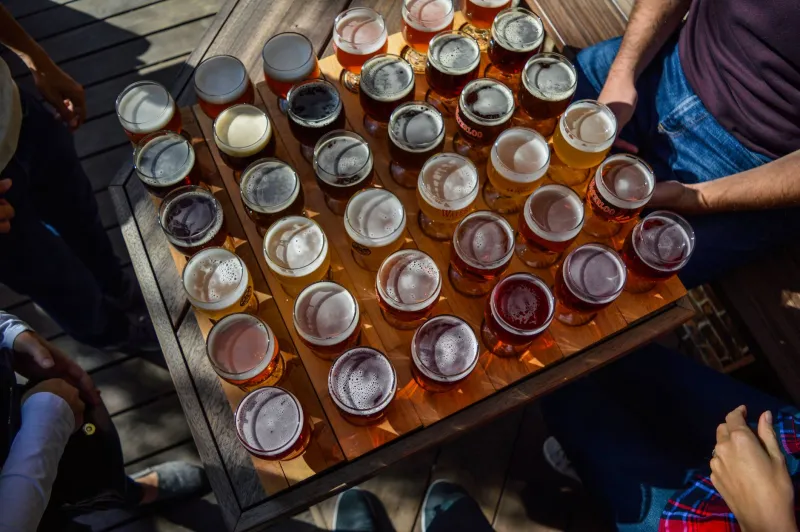
So we decided to actually run one. No labels. No context. Just beer in identical cups and a room full of people willing to put their palates on the line.
Setting Up the Test
We organized three separate blind tasting sessions, each focused on a different style: IPAs, lagers, and stouts. Each session included a mix of participant types — self-described craft beer enthusiasts who drink multiple craft beers per week, casual drinkers who grab whatever's available without much brand loyalty, and a small group of industry folks including a homebrewer, a taproom manager, and a certified cicerone.
For each style, we poured three to four options: at least one widely available craft example, one regional or independent craft option with a strong local following, and one well-known commercial product. All pours were identical in volume, served at the same temperature, in the same style of glass. Participants were asked to rank the beers by preference and, separately, to identify which one they believed was the commercial product.
We kept the results anonymous and didn't tell participants how they performed until after the session.
The IPA Round: The Most Confident, The Most Surprised
IPAs were where the craft enthusiasts were most certain — and where the results were most interesting.
The commercial IPA in our lineup was a nationally distributed brand that has invested heavily in its hop profile over the last several years. It's not the same product it was a decade ago, and that matters. Several participants who correctly identified it as the commercial option did so not because it tasted worse, but because they recognized it — the same way you might recognize a song you've heard before without being able to name it.
Here's the part that got people talking: when asked purely about preference, nearly 40 percent of self-described craft enthusiasts ranked the commercial IPA in their top two. When that was revealed after the session, the reactions ranged from genuine surprise to mild defensiveness.
"I knew something was off about my second pick," one participant said, laughing. "I kept second-guessing myself."
The cicerone in the group was the most accurate identifier overall — correctly flagging the commercial option based on what she described as a "cleaner, less variable" hop character. But even she noted that the gap between craft and commercial IPAs has narrowed considerably in recent years as big brewers have gotten more sophisticated about hop sourcing and dry-hopping techniques.
Lagers: Where Things Got Really Interesting
If the IPA round surprised people, the lager round genuinely rattled some assumptions.
Lager is a style where commercial producers have historically dominated, and the craft lager renaissance is still relatively young. Several of the enthusiast participants admitted upfront that lager wasn't their strong suit. That honesty turned out to be well-placed.
The craft lager in our lineup — a well-regarded pilsner from an independent regional brewery — was identified as the commercial product more often than the actual commercial product. Participants who preferred bolder, hoppier beer styles tended to read its clean, precise character as industrial rather than intentional.
This is a real perception problem that craft lager brewers talk about openly. When you've trained your palate to associate "interesting" with "intense," a beautifully balanced lager can read as boring rather than technically impressive.
The casual drinkers, interestingly, performed better in the lager round than the enthusiasts. Without strong preconceptions about what craft was supposed to taste like, they responded more directly to what was in the glass. Several of them ranked the craft pilsner as their top pick.
Stouts: The Clearest Divide
Of the three styles, stouts produced the most consistent results. Participants across all groups were most accurate at identifying the commercial option, and the preference gap between craft and commercial was widest here.
The reason, most participants agreed, came down to complexity. The craft stouts in our lineup — a dry Irish-style stout and a roastier American imperial — offered noticeably more layered flavor experiences. The commercial stout was pleasant and smooth, but several tasters described it as "one-note" compared to the others.
The cicerone framed it well: "With stouts, craft brewers have had the most room to differentiate. The commercial version is optimized for approachability. The craft versions are optimized for interest. Those are genuinely different goals, and you can taste the difference."
What Does This Actually Tell Us?
A few honest takeaways from the whole experiment:
Preference and quality aren't the same thing. Several participants preferred the commercial options in the IPA round, and that's completely valid. Taste is subjective. The craft beer community sometimes loses sight of that.
Context shapes perception more than we admit. When people drink from branded glassware in a taproom they love, they're tasting the whole experience — the atmosphere, the story, the community. Strip that away and the beer has to stand entirely on its own. That's a different test.
Commercial beer has gotten better. This is probably the most uncomfortable takeaway for hardcore craft advocates, but it's true. Big producers have been watching the craft industry closely for years and have made real improvements to their hop-forward products. The gap is smaller than it was in 2010.
Craft's real advantage may be variety. The strongest argument for craft isn't that every craft beer beats every commercial beer in a blind test. It's that craft offers a range of styles, ingredients, and approaches that commercial brewing simply doesn't prioritize. That's a meaningful difference — just a different one than most people articulate.
The Bottom Line
Does this mean you should swap your local brewery's IPA for a six-pack of something from a gas station cooler? Absolutely not. But maybe it means you can ease up on the certainty a little. Drink what you enjoy. Support the breweries whose work and values you believe in. And maybe — just maybe — be willing to be surprised by what ends up in your glass when the label isn't staring back at you.