Stop Saying 'It Tastes Good': A Beginner's Guide to the Craft Beer Flavor Wheel
We've all been there. You take a sip of something genuinely excellent — maybe a hazy New England IPA from your favorite local taproom, or a rich barrel-aged porter that hits just right on a cold November night — and someone asks what you think. And you say... "It's good. Really good."
That's not a bad answer. But it's not a very satisfying one, either. Especially when you know there's something more going on in that glass. Something bright and citrusy. Something earthy. Something that lingers in the back of your throat in a way that feels almost spicy.
That's where the craft beer flavor wheel comes in.
What Is the Flavor Wheel, Exactly?
The beer flavor wheel was originally developed in the 1970s by a group of sensory scientists and brewing researchers who wanted a standardized vocabulary for describing beer. The version most widely used today has been refined over the decades, and while it might look intimidating at first glance — a colorful, multi-ringed circle packed with terms like "estery," "phenolic," and "diacetyl" — it's actually a remarkably practical tool once you get the hang of it.
Think of it in layers. The innermost ring contains broad categories: fruity, malty, hoppy, roasted, sour, and so on. As you move outward, those categories get more specific. "Fruity" breaks down into citrus, tropical, berry, stone fruit. "Hoppy" splits into floral, herbal, resinous, and spicy. By the time you hit the outer ring, you're talking about very precise descriptors — grapefruit zest, fresh-cut grass, black pepper, toasted bread.
The wheel doesn't tell you what a beer should taste like. It gives you the language to describe what you're actually experiencing.
Starting With Aroma: Your Most Powerful Sense
Before you take a sip, smell your beer. Seriously — give it a good sniff. Somewhere around 70 to 80 percent of what we perceive as flavor is actually aroma, which means your nose is doing a lot of the heavy lifting before your tongue even gets involved.
Swirl the glass gently (yes, like wine — it works for beer too), then take a slow inhale. What hits you first? Is it sharp and piney, like a West Coast IPA? Soft and bready, like a German lager? Sweet and roasty, like a coffee stout?
On the flavor wheel, aroma descriptors tend to live in the outer rings. Try to anchor what you're smelling to something familiar. If it reminds you of a bag of dried apricots, that's a stone fruit ester — common in Belgian ales and certain English styles. If it smells like a fresh citrus peel you just squeezed, you're likely picking up on hop compounds called terpenes, especially myrcene and linalool, which show up heavily in American IPAs and pale ales.
Don't overthink it. The goal isn't to be technically correct — it's to build a connection between what your senses are detecting and words you can actually use.
The First Sip: Breaking Down Flavor
Now taste it. But don't rush. Let the beer sit on your palate for a moment before you swallow.
Pay attention to where you're tasting things. Sweetness tends to register at the tip of your tongue. Bitterness builds at the back. Acidity hits the sides. That geography matters when you're trying to isolate individual elements.
Here's a quick breakdown of the major flavor categories you'll encounter on the wheel:
Malty: Think bread, biscuit, caramel, toffee, chocolate, and roasted coffee. These flavors come from the malt — specifically from how the grain was kilned or roasted before it hit the brew kettle. A Munich dunkel is going to sit heavily in the malty zone, while a light pilsner will barely touch it.
Hoppy: This is where it gets fun. Hops can taste like pine resin, tropical fruit, fresh herbs, flowers, or even garlic and onion (which isn't always a flaw, depending on the style). American craft brewers have pushed hop flavor into genuinely wild territory over the last two decades — if you've ever tasted a beer and thought "is that mango?", you were probably picking up on a hop variety like Mosaic or Citra doing its thing.
Fruity/Estery: These flavors come from yeast, not hops. Esters are chemical compounds produced during fermentation, and they can smell and taste like banana, pear, apple, or bubblegum. Belgian witbiers and hefeweizens are classic examples of highly estery beers.
Roasted: Stouts and porters live here. Look for notes of dark chocolate, espresso, charcoal, and even a faint smokiness. The darker the malt, the more intense the roast character.
Sour/Acidic: Kettle sours, Berliner weisses, goses, and wild ales all play in this space. Sourness can range from a gentle, yogurt-like tartness to the face-puckering intensity of a Lambic. The wheel breaks this down further into lactic (smooth, creamy sourness) and acetic (sharper, vinegar-like).
Mouthfeel: The Dimension Most People Skip
Flavor isn't just about taste and aroma — it's also about how a beer feels in your mouth. This is mouthfeel, and it deserves its own moment of attention.
Is the beer light-bodied and crisp, almost water-thin? Or thick and chewy, coating your tongue? Is there a tingly carbonation that scrubs everything clean, or is it soft and almost still? Does it finish dry, or does sweetness linger?
Mouthfeel descriptors on the flavor wheel include things like astringent, creamy, warming (that gentle heat from higher alcohol), and oily. A well-crafted nitro stout should feel velvety. A dry-hopped hazy IPA often has a soft, pillowy texture. A bone-dry German Kölsch should leave your palate feeling refreshed and clean.
Once you start paying attention to mouthfeel, you'll realize it changes your entire experience of a beer — sometimes even more than the flavor itself.
Putting It All Together at the Taproom
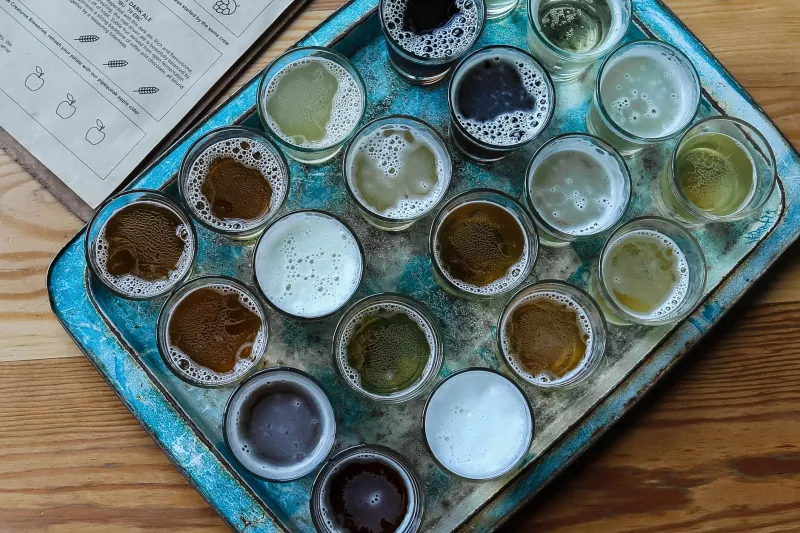
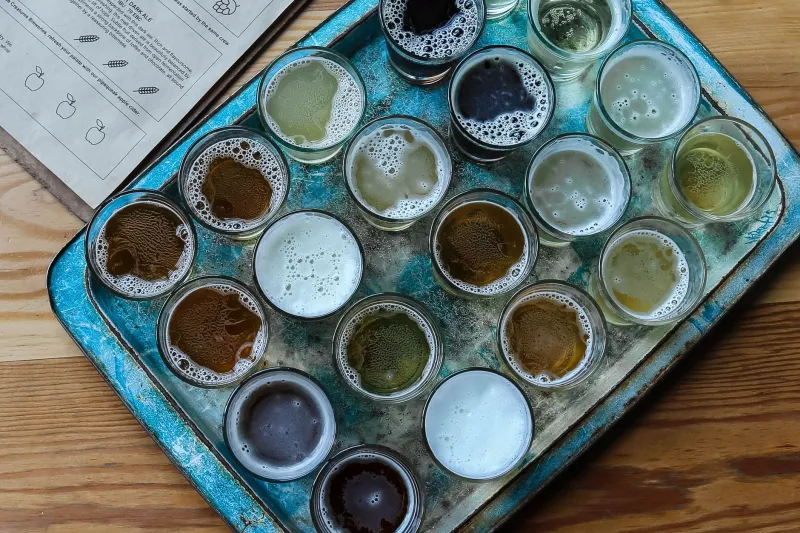
You don't need to carry a printed flavor wheel into your local brewery (though honestly, some taprooms have them on the wall — look around). The real goal is to internalize the categories well enough that you can start reaching for more specific language naturally.
Next time you're at a taproom, try this: before you order, ask the bartender what flavors they'd use to describe the beer you're eyeing. Then taste it and see if you agree. Push yourself to add one specific descriptor beyond what they offered. Maybe they said "citrusy" and you're picking up something more like blood orange than lemon. Say that.
Brewers love this kind of conversation. It tells them their beer is landing the way they intended — or gives them useful feedback when it isn't.
The More You Taste, the More You'll Find
Learning to use the flavor wheel is really just learning to pay attention. Your palate already knows more than you think — it just needs a vocabulary to work with. The more styles you try, the more reference points you build. A smoky rauchbier suddenly makes the faint smokiness in a dark lager make sense. A sip of a straight-up Lambic reframes what you thought "sour" meant.
Craft beer is endlessly layered, and that's exactly what makes it worth exploring. So next time someone hands you a pint and asks what you think, you'll have a lot more to say than "it's good."
And trust us — that's a much better conversation.